Solid and Oil Fragrance Lead Times: A First Founder's Realistic Calendar
A solid or roll-on fragrance order usually takes longer than a spray order of the same size, and the extra weeks are almost never in the filling hall. They sit in base development, in compatibility and heat testing, and in the component tooling that these formats need. A founder working backwards from a shelf date should plan the calendar around three long-lead items - base selection, stability testing and packaging components - and treat everything else as work that can be compressed or run in parallel. Getting that order right is the difference between a launch date and a launch excuse.
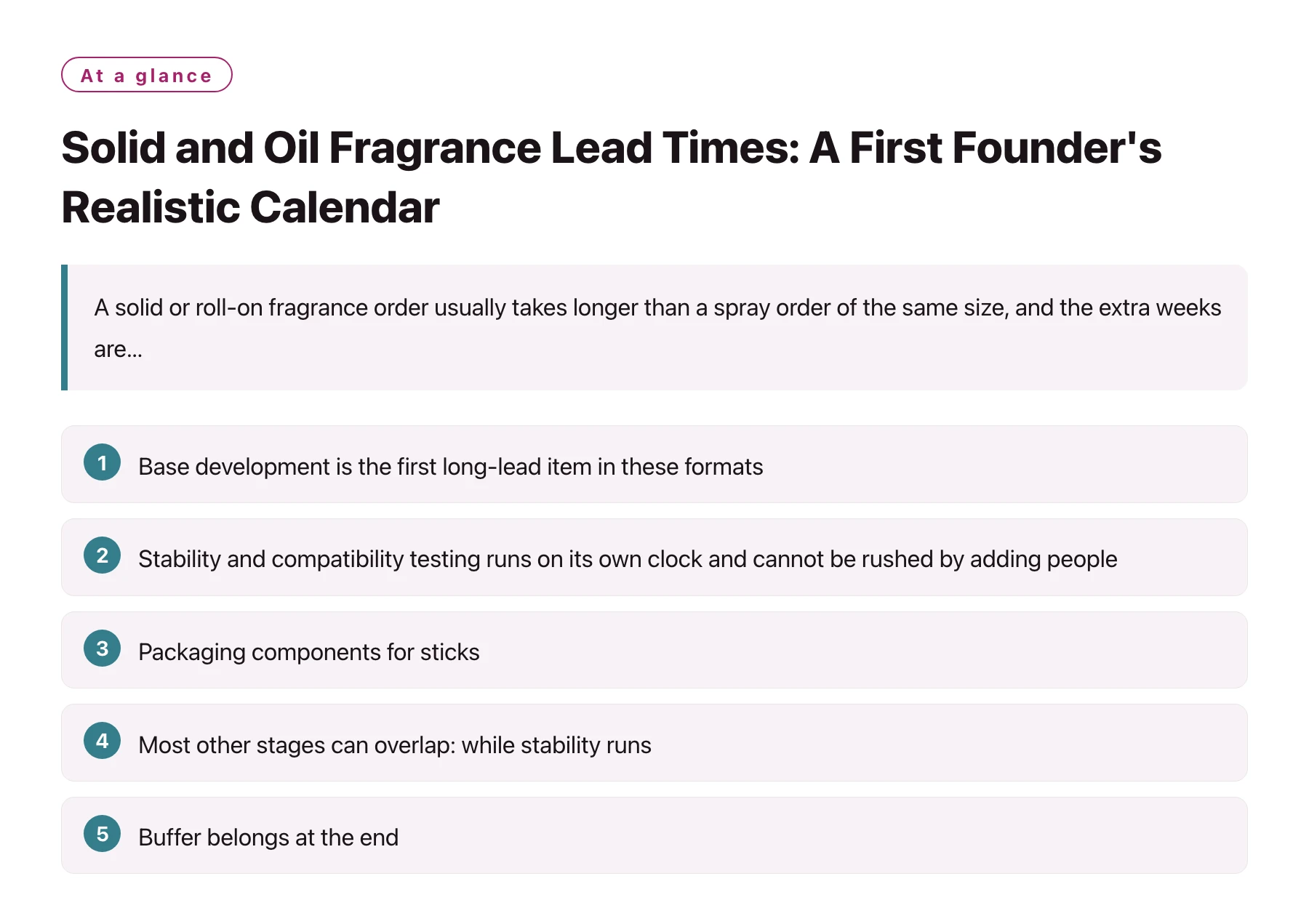
Key takeaways
- Base development is the first long-lead item in these formats, because a wax or carrier system has to be chosen and tested before sampling can be meaningful.
- Stability and compatibility testing runs on its own clock and cannot be rushed by adding people, so it should start as early as a provisional formula allows.
- Packaging components for sticks, pans and rollerballs usually carry tooling or minimum order quantities that add weeks before filling can even be scheduled.
- Most other stages can overlap: while stability runs, the brand can approve artwork, confirm fill weight and settle labelling, rather than waiting for a report.
- Buffer belongs at the end, not spread evenly, because the last two weeks of a first order are where documentation, freight booking and rework compete for the same time.
Ask three factories for a lead time on a solid fragrance and you will usually get three different numbers, because each one is quoting a different starting point. One counts from the approved sample, one counts from the purchase order, and one is quietly quoting the filling window only.
That ambiguity is expensive for a first-time founder, particularly one with a fixed launch date, a pre-order campaign or a retail slot. The way out is to build the calendar yourself, stage by stage, and then ask each supplier to confirm or challenge the individual stages rather than the total.
This guide sets out the stages in the order they consume calendar time, marks the ones that can run in parallel, and lists the four planning errors that most often move a launch.
Where the extra weeks come from in solid and oil formats
A spray project starts from a concentrate and a bottle. A solid or oil project starts from a concentrate, a base, and a package that has to work with that base. The base is not a catalogue item you can simply drop in, because the same fragrance behaves differently in a firm wax, a soft balm and a light carrier oil.
Base selection therefore comes first, and it is a sampling exercise in its own right. Expect to evaluate more than one base against your fragrance, judge them on skin feel, surface finish, release and heat behaviour, and then re-test the winner at the planned fragrance load. Skipping that step to save two weeks usually costs more than two weeks later, because a base change after bulk testing invalidates the testing.
The second source of extra time is heat and transport testing, which matters more here than in a spray. A solid that performs perfectly in an air-conditioned showroom can soften or sweat in a delivery van, and the only way to know is to test the finished unit in its packaging at an elevated temperature.
Experience compresses the front of the calendar rather than the middle. A manufacturer that has built these formats for years starts from a set of base options it already understands, so screening is faster and fewer rounds are wasted, while the testing that protects the product still runs in full Xuelei Fragrance.
A stage-by-stage view of a first order
| Stage | What it involves | Where the calendar usually slips |
|---|---|---|
| Brief and base screening | Written brief, base options proposed, first bench samples built on the shortlisted base. | The brief is left open, so the factory tests several bases at once and the founder cannot compare them fairly. |
| Sampling rounds | Fragrance and base adjusted together, with each round judged on the finished base rather than on a blotter. | Feedback arrives in fragments over several days instead of one consolidated set of comments. |
| Compatibility and stability | Finished product in final packaging held at room and elevated temperature, checked for weeping, bloom, colour and odour drift [1]. | Testing starts only after the sample is approved, so it becomes a serial step rather than a parallel one. |
| Components and tooling | Stick mechanisms, pans, tins, rollerball housings and closures produced or ordered to spec. | The component is chosen after the formula is fixed, and a tooling or minimum order delay appears late. |
| Artwork and labelling | Ingredient list, allergen declaration, net content and any market-specific wording approved. | The ingredient list is drafted before the formula is locked, so it has to be redone. |
| Bulk production | Compounding, base preparation, filling, cooling or rollerball insertion, packing. | Material for the base or the component arrives late, so the line slot moves. |
| Documents and freight | Batch records, certificates, transport documents and booking. | Documents are requested after the batch is packed, and the container waits. |
Treat the list as a sequence to be questioned rather than a fixed pipeline. Several rows can run at the same time, and a supplier that supports both OEM and ODM work will usually be able to tell you which of these stages it controls directly and which depend on outside vendors a manufacturer that supports OEM and ODM.
Four planning errors that move a launch date
The first error is starting stability testing too late. It is the only stage in the list that genuinely cannot be accelerated, because a real-time observation takes the time it takes. Industry guidance for cosmetic manufacturers treats that testing and documentation as part of the evidence base behind a product, which is why it is not a step a supplier will happily shorten [2]. A provisional formula can go into test while the next sampling round continues, and that single decision often saves three to four weeks without any risk.
The second error is choosing packaging after the formula. Stick mechanisms and rollerball housings have their own lead times, their own minimum quantities and their own compatibility questions, and they interact with the base. Selecting them early keeps the two tracks parallel rather than sequential.
The third error is leaving the label until the end. Ingredient names, allergen declarations and net content all depend on a locked formula and a fixed fill weight, so artwork cannot be finalised before those exist. A founder who wants to hold a date should fix fill weight early, because it is a decision rather than a discovery.
The fourth error is booking freight before the documents are ready. A batch certificate, a transport safety data sheet and any certificate of origin are produced after production, and a container booked a week too early turns into storage cost or a missed sailing. The fix is mundane: ask for the document list at order confirmation and confirm the expected issue date for each one.
There is a structural way to reduce all four risks at once: work with a partner that keeps base preparation, compounding, filling and testing in one place. That removes the hand-offs between vendors, which is where most of the invisible waiting happens, and it gives one team responsibility for the calendar fragrance manufacturing under one roof.
Ask for the schedule in stage form, with a named owner and a date for each stage. A single total lead time hides the fact that four stages are waiting on you, and those are the weeks a founder can actually recover.
Sources
- SGS: Cosmetics, Personal Care & Household Testing —— Testing, inspection and certification services for cosmetics and personal care, including microbiological, stability and safety testing aligned with cosmetics GMP.
- Cosmetics Europe —— The European trade association for the cosmetics and personal care industry, publishing guidance, positions and market information.
Frequently asked questions
Is a solid or roll-on fragrance always slower than a spray?
Usually, but not always. These formats add base development and heat testing, which a spray does not need. A spray can still be slower if its bottle or cap requires tooling. The useful comparison is stage by stage, not format against format.
How early can stability testing start?
As soon as there is a provisional formula with the intended base and fragrance load. It does not have to wait for final approval, and starting early is the single most effective way to protect a launch date, because the test duration itself cannot be shortened.
Which stages of a first order run in parallel?
Stability testing, packaging component production, artwork preparation and label review can all progress at the same time. Sampling rounds and bulk production cannot overlap, because bulk has to follow the approved reference.
How much buffer should a first-time founder build in?
Concentrate it at the end rather than spreading it evenly. The final weeks are where documentation, rework and freight booking compete, and a first order rarely finishes on the optimistic date. A realistic buffer placed there absorbs a slip without moving the shelf date.
What should I ask for instead of a total lead time?
Ask for the stage list with dates, a named owner for each stage, and an explicit note of which stages depend on outside vendors. That answer reveals where the schedule is genuinely tight and where a decision by you, not by the factory, is the real constraint.